

A hotel website that turns interest in your property into a booking journey

Before and during website development, we define content structure, the Book Now hierarchy, mobile experience, booking engine transitions, and tracking and SEO requirements so the site supports direct hotel sales.

Initial setup and project services

How we work with a hotel

Nikton Hospitality is a hotel marketing agency based in Zagreb. We work remotely with independent 4- and 5-star hotels, including hotels in Austria and Germany.

Onboarding means access to Google Ads, Meta, GA4 and the booking engine, an agreed goal, a monthly report and one monthly conversation.

For hotels in Austria and Germany, reports, emails and documents are in German. Calls and meetings are in English.

We work with the booking engine the hotel already uses. Before we start, we check how the engine sends data to GA4 and what needs to be fixed.

A visit to the hotel in Austria or Germany is possible by agreement.

Monthly management from €1,200 + VAT. The starting scope covers one hotel and one agreed advertising channel - Google Ads or Meta Ads. It includes campaign optimisation, performance monitoring through the existing measurement system, a monthly report and one monthly conversation.

What is included in the optimization of the hotel website and booking UX?

Optimisation connects offer content, Book Now calls to action, mobile experience and the transition to the booking engine. It checks whether guests can understand the terms, find availability and complete a booking. Consulting, development and implementation each have a separately agreed scope.

The scope and fee for this service are agreed separately based on your hotel's goals, the current system and the access required.

A guest reviews hotel rooms and the booking journey on a tablet and phone

AI illustration

A hotel website can look excellent and still make booking difficult

When creating a hotel website, much attention naturally goes to photography, design, animation and presenting the property. These matter, but they are not enough.

Guests visit a website for more than a look around the hotel. They need to be able to:

  • -understand the difference between rooms and accommodation units
  • -find price, availability and relevant conditions
  • -recognise the benefits of booking directly
  • -find a suitable offer or package
  • -move easily into the booking engine
  • -continue the process on the mobile device without confusing steps

Problems arise when the website's appearance is defined before the booking journey.

The website may then have good content and traffic, but the guest:

  • -does not see a clear Book Now CTA
  • -does not understand which room or offer to choose
  • -leaves the website to check the price on an OTA
  • -loses the context of the page they were viewing when entering the booking engine
  • -abandons the process because of mobile experience, language, currency or a technical obstacle
  • -cannot easily complete the journey started on the campaign landing page

Why a beautiful website does not necessarily mean more bookings

An aesthetic redesign without a booking specification can carry old problems into the new website. If the new site is assessed only on design and technical functionality, important business questions can remain unanswered:

  • -does every key page lead the guest towards the next step
  • -do rooms, packages and offers have a clear hierarchy
  • -is Book Now visible enough on desktop and mobile
  • -is there a clear transition from content to availability
  • -do campaign landing pages support specific dates and offers
  • -is the traffic source passed to the booking engine
  • -can user actions before and after the Book Now click be tracked
  • -are all necessary GA4, GTM and dataLayer requirements covered
  • -whether SEO migration, canonicals, redirects and metadata are included in the launch plan

The consequences can be:

  • -increase in traffic without a corresponding increase in bookings
  • -less effective use of Google and Meta campaigns
  • -more guests leaving for OTA channels
  • -loss of traffic sources in the booking engine
  • -unclear landing pages for seasonal promotions
  • -more expensive changes after launch
  • -a lack of data needed to assess the new website's effectiveness

The goal is not to add as many conversion elements as possible. The goal is to remove the barriers between the interests of the guest and the completed booking.

The guest journey from the website to the booking engine

We view the hotel website as the first part of a booking funnel, not as a separate presentation platform.

1. Arriving on a relevant page

  • Google brand or non-brand search
  • Meta campaign, organic result or direct visit
  • recommendation, newsletter or special offer
  • the site must match the intent of the user

2. Understanding the hotel and its offer

  • whether the hotel meets the needs of the guest
  • differences between accommodation units
  • what is included in the price and what are the benefits
  • is there an offer relevant to the dates or reason for the stay

3. Deciding to check availability

  • Book Now CTA clearly visible and logically positioned
  • consistent throughout the website and adapted for mobile
  • linked to the relevant dates, room or offer where possible

4. Transition to a booking engine

  • language, currency and selected dates are retained
  • the offer context and traffic source are passed through
  • cross-domain tracking works
  • the experience is sufficiently consistent in appearance and content

5. Completing the booking

  • Book Now click, entry into the booking journey and room views
  • room selection, start of checkout and completed booking
  • revenue tracking according to the booking engine's capabilities

The exact scope depends on the capabilities of the booking engine and the technical implementation.

What is included

1. Business brief and website goals

  • understanding of hotel positioning and target markets
  • reviewing accommodation, facilities, offers and business units
  • defining the role of direct bookings
  • review of the existing website, booking processes and campaigns
  • defining project goals and key user journeys

2. Information architecture

  • main navigation and accommodation structure
  • pages for rooms, apartments, villas or residences
  • offers, packages, restaurant, spa, events and destination content
  • landing pages for campaigns, blog and SEO content
  • contact, practical information and legal pages

3. Structure of rooms, offers and packages

  • name and hierarchy of accommodation units
  • benefits, photos, descriptions and practical information
  • CTAs leading to availability and offer conditions
  • connection between the package and the booking engine

4. CTA hierarchy and the booking journey

  • primary Book Now CTA on different types of pages
  • CTAs for rooms, offers, spa, restaurants and events
  • sticky mobile CTAs where appropriate
  • relationship between direct booking and other sales activities

5. Mobile booking UX

  • navigation, readability and speed of finding offers
  • sticky CTA elements and date selection
  • transition to the booking engine, forms and data entry
  • displaying prices and terms, and checking key page performance

6. Booking engine transition

  • Book Now URL structure and deep links
  • date, language and currency transfer
  • cross-domain configuration and referral problems
  • content consistency and the confirmation process

7. Tracking and dataLayer requirements

  • Book Now clicks, room views and the start of the booking journey
  • room selection, checkout and completed booking
  • value, currency and parameters for campaigns
  • telephone, email and enquiry events

8. SEO requirements before development

  • URL structure, redirect plan and canonical rules
  • metadata, heading structure and internal links
  • schema markup and multilingual architecture
  • sitemap, Search Console and preserving organic performance during migration

9. Wireframe and design review

  • navigation, room pages and landing pages
  • offers, packages, CTA hierarchy and mobile displays
  • booking transitions, forms and contact flows

10. Pre-launch QA

  • navigation, Book Now CTAs and links to the booking engine
  • mobile displays, languages, currencies and forms
  • tracking events, cross-domain behavior and cookie consent
  • metadata, redirects, indexing and speed of key pages
  • booking confirmation and thank-you process

What your hotel receives at the end of the project

A clear specification for the website agency

  • page structure and booking journeys
  • CTA hierarchy and required landing pages
  • tracking, dataLayer, SEO and migration requirements
  • booking engine integrations

Fewer unplanned decisions during development

  • key issues defined before they become costly or technically complex

Clearer partner responsibilities

  • what Nikton Hospitality, the website agency and booking engine provider each do
  • what the hotel needs to provide and what requires an additional project

A website ready for campaigns and measurement

  • relevant landing pages for Google and Meta campaigns
  • clearly defined conversion events
  • a controlled launch with booking journey checks before publication

KPIs we track after launch

There is no universal conversion rate that every hotel website must achieve. The result depends on price, availability, market, reputation, season, booking window and traffic quality.

The journey to the booking engine

  • Book Now clicks and click-through rate
  • the rate of transition from website to booking engine
  • entries by page, market, language and device

Landing pages and content

  • visits to room and offer pages
  • clicks to check availability and campaign landing page conversion
  • telephone, email and enquiry clicks
  • interest in restaurant, spa, events and other facilities

Booking funnel

  • displays of available rooms, room selections and start of checkout
  • completed bookings and abandonment at each step
  • average booking value

Mobile experience

  • Book Now click rate on mobile
  • mobile transition to the booking engine and booking conversion rate
  • differences between desktop and mobile
  • technical errors and key page performance

Data quality

  • preserving traffic sources
  • reconciling bookings and revenue
  • event accuracy and duplicate conversions
  • referral issues and the impact of consent settings

How we work with your website agency

Step 1

Audit of the current setup and goals

We review the existing website, booking engine, campaigns, analytics, accommodation offer and business priorities.

Step 2

Specification and brief

We define architecture, key user journeys, CTA hierarchy, landing pages, booking transition, tracking and SEO requirements.

Step 3

Collaboration during design and development

We participate in wireframe reviews, design and implementation, and coordinate issues between hotels, web agencies and booking engine providers.

Step 4

Pre-launch QA and priorities

We test key user journeys, tracking, mobile experience, SEO migration and booking transitions and prepare a list of changes before launch.

Nikton Hospitality works alongside your website agency. If the hotel has not selected a partner, we can help define the brief and assess proposals, while website development remains a separate scope.

Connection with direct bookings

The hotel website's role extends beyond the Book Now click. It determines the quality of users entering the booking engine and the context guests have before seeing prices and availability.

A good booking journey helps the guest:

  • -choose the right room and understand the value of the offer
  • -find the relevant package and recognize the benefits of direct booking
  • -easily check availability and continue without interruption

For the hotel, this means the ability to:

  • -better use of traffic from campaigns and organic searches
  • -reduce losses before entering the booking engine
  • -create landing pages for quieter dates
  • -communicate direct booking benefits more clearly
  • -better measure the contribution of individual pages and channels
  • -identify where users drop off more quickly
  • -make decisions based on the booking process, not just web traffic

A website alone cannot guarantee more bookings. Price, availability, the offer, demand and the booking engine also play important roles. Its task is to remove obstacles and guide guests effectively to the next step.

What is not included

  • -complete visual design and development of the entire website
  • -creating or redesigning the hotel's identity
  • -hosting, server administration and booking engine development
  • -booking engine licenses and professional photography
  • -writing all copy and translations
  • -day-to-day code maintenance after launch
  • -unlimited number of design revisions
  • -channel management, revenue management and OTA content management

Frequently asked questions

Are you a web agency?

Not in the traditional sense. Nikton Hospitality defines how the hotel website should support direct bookings, campaigns, the booking engine, tracking and management goals. The hotel's website agency or development partner generally handles design and development. We prepare specifications, participate in the project, review solutions and carry out pre-launch QA.

Can you work with our existing website agency?

Yes. This is our most common working model. We give the website agency clear hospitality and booking context while it handles design, development and technical delivery. We help reduce uncertainty between the hotel, campaigns, booking engine and website production, while keeping your existing partner in place.

Can you work on an existing websitesite without a complete redesign?

Yes. Significant improvements can often be made through a better CTA hierarchy, improved room pages, new landing pages, a better mobile experience, clearer direct booking benefits, smoother transitions to the booking engine, and tracking and analytics. A full redesign is not always the first or best step.

When should you be involved in the project?

Best before defining the structure and wireframes. If we only engage after the design or development is complete, individual changes may be more expensive, slower or technically limited. We can also engage in an existing project, but first we assess which decisions still make sense to change.

Do you also work with a booking engine provider?

Yes. We coordinate questions about deep links, languages and currencies, passing dates, cross-domain tracking, ecommerce events, the thank-you page, booking confirmation and the provider's system limitations. The provider is responsible for technical capabilities and changes within its own system.

How long does a project like this take?

It depends on the scope of the website, the number of languages, accommodation units, hotel facilities and the stage in which the project is located. The project can include a short audit of the existing website, pre-redesign specification, multi-month support during design and development or a separate pre-launch QA. The deadline and the fee are defined after the review of the project and the partners involved in the development.

Who implements tracking and SEO requirements?

Nikton Hospitality can prepare specification, dataLayer documentation, event plan and SEO requirements. As a rule, implementation is carried out by web developers, booking engine provider, GTM/analytics expert or Nikton Hospitality through a separately agreed tracking setup. After the implementation, we carry out a quality check.

Can you guarantee that the new website will generate more bookings?

No. Reservations are affected by price, availability, demand, hotel reputation, quality of accommodation, market, seasonality, campaigns and booking engine. We can ensure that the project has a clearly defined booking journey, higher quality requirements, better measurement and fewer obstacles that the web can control.
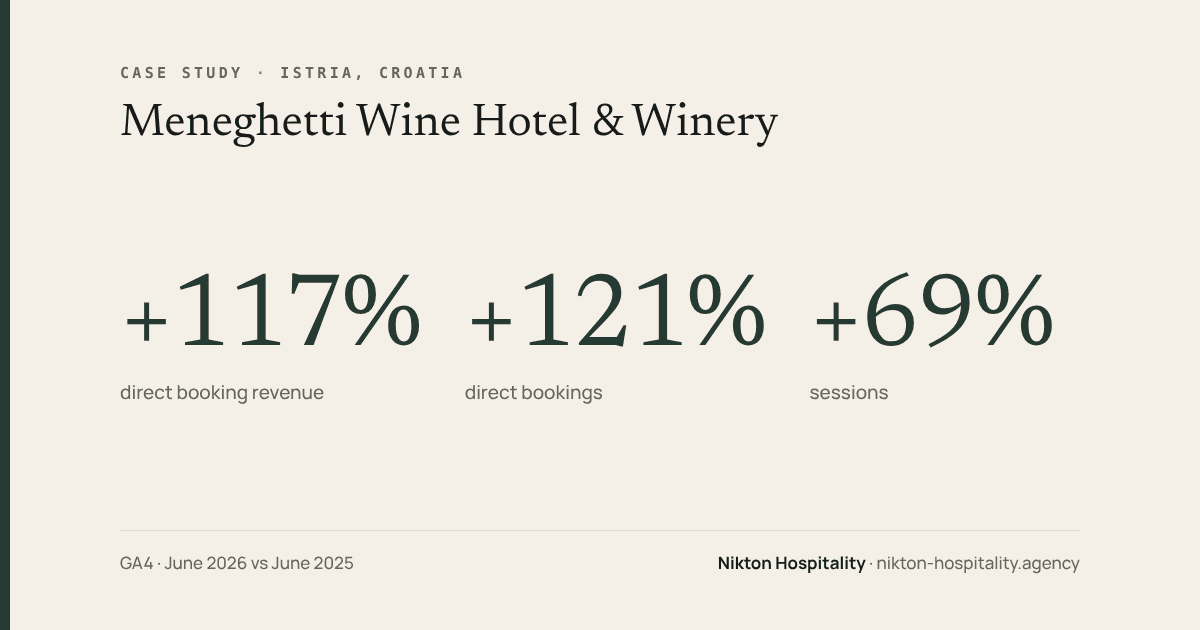
Meneghetti Wine Hotel & Winery: +117% direct booking revenue, +121% bookings and +69% sessions, GA4, June 2026 vs June 2025.

Case study · Meneghetti Wine Hotel & Winery

At Meneghetti, the booking journey is structured from Book Now click on the website to a confirmed booking in the booking engine.

Related articles

A laptop on a coffee table in a bright hotel suite - AI illustration.

Hotel management

Hotel website UX for direct bookings

How to review a hotel website and booking journey: offer clarity, mobile display, prices and conditions, the transition to the engine and completed booking measurement.

·4 min read
A mobile phone on a stand beside a hotel room window - AI illustration.

Booking engine

Mobile booking experience: where hotels lose bookings

Check your mobile path from your ad to your booking confirmation: dates, prices, data entry, payment and measurement. A practical procedure for hotel and booking engine suppliers.

·4 min read

Check whether your hotel website guides guests towards a booking

We will review website structure, the Book Now hierarchy, mobile experience, the booking engine transition, tracking and key landing pages, then identify the main obstacles and priorities.

The first conversation is based on your hotel's actual website and booking journey, without a generic sales presentation.