
Google Ads
Google Ads for hotels: brand vs non-brand campaigns
Brand and non-brand campaigns play different roles in hotel marketing. Here is how to separate them, track them and interpret the results.
·4 min read
We link the campaigns to the booking engine, revenues and business priorities of the hotel so that the management knows which markets, queries and campaigns really bring bookings.
Ongoing monthly management
Nikton Hospitality is a hotel marketing agency based in Zagreb. We work remotely with independent 4- and 5-star hotels, including hotels in Austria and Germany.
Onboarding means access to Google Ads, Meta, GA4 and the booking engine, an agreed goal, a monthly report and one monthly conversation.
For hotels in Austria and Germany, reports, emails and documents are in German. Calls and meetings are in English.
We work with the booking engine the hotel already uses. Before we start, we check how the engine sends data to GA4 and what needs to be fixed.
A visit to the hotel in Austria or Germany is possible by agreement.
Monthly management from €1,200 + VAT. The starting scope covers one hotel and one agreed advertising channel - Google Ads or Meta Ads. It includes campaign optimisation, performance monitoring through the existing measurement system, a monthly report and one monthly conversation.
Google Ads management connects guest searches with the hotel's offer: market and keyword planning, separating brand and non-brand campaigns, optimising ads and verifying bookings and costs. Nikton Hospitality interprets performance alongside availability, seasonality and the quality of existing measurement.
Monthly management from €1,200 + VAT. The starting scope covers one hotel and one agreed advertising channel - Google Ads or Meta Ads. It includes campaign optimisation, performance monitoring through the existing measurement system, a monthly report and one monthly conversation. Advertising budget, initial setup, additional channels and production are not included in the starting monthly fee.

AI illustration
Many hotels invest in Google Ads, but reports still stop at clicks, CPC, and the number of conversions the platform reports itself. Brand and non-brand demand are often displayed as a single result, campaigns are not associated with occupancy and availability, the booking engine is not properly connected to the website and analytics, and it is not clear how much a hotel pays for a single booking and how much revenue it brings. Then a high ROAS may look good, but it doesn’t explain how much the campaign brings in new demand and how much it just takes over an existing brand’s intent.
Without a clear campaign structure and quality measurement, the budget is difficult to focus on the real business priorities of the hotel:
The monthly review answers business questions, not just marketing metrics:
The result is one conclusion connecting campaigns with the hotel's business context.
There is no single KPI that explains the whole result. We use ROAS, but we do not read it in isolation:
Step 1
Overview of account structure, keywords, markets, bidding strategies, conversions, landing pages and quality of GA4/bookings tracking.
Step 2
Separating brand, non-brand, remarketing and market-specific campaigns, then aligning them with occupancy, seasonality and the hotel's offer.
Step 3
Checking whether the journey from an ad through the booking engine to a booking and its revenue can be tracked reliably.
Step 4
Optimization of campaigns, analysis of results, management reporting and defining priorities for the next period.
Google Ads captures users at different stages of the decision: part searches for a specific hotel name (brand), part just searches for a destination, type of accommodation or experience (non-brand), and part returns through remarketing. We link the campaigns to the website, booking engine and booking data to make it clear from which campaign the demand comes, from which market, what is the value of the booking and what is the cost per booking. Attribution is not perfect due to consent, multiple devices and longer booking windows, so we clearly separate the directly measured results from the assisted contribution.
Brand campaigns reach guests who are already looking for a hotel name. Non-brand campaigns reach users who are looking for a destination or type of accommodation, but do not yet know the hotel. Mixing these two types conceals the actual contribution of the new demand.
Yes, if the hotel website, GA4, GTM and booking engine are properly connected. However, consent, multiple devices and a longer booking window can limit attribution, so we separate directly recorded bookings from the modeled and assisted value.
There is no universal amount. The budget depends on the markets, competition, season, capacity, value of the booking and the objectives of the campaigns. The recommendation is given after reviewing the actual demand and the existing results.
Often, yes: they protect visibility against OTA and competitor ads and allow control over the message and offer. They should also be reported separately, so existing brand demand is not presented as entirely new demand.
Brand campaigns often record the result faster because they capture the existing intention. Non-brand campaigns usually need more time to learn and optimize. The speed of the results depends on the season, budget, offer, web and booking experience.
The systems use different attribution models, time zones and conversion windows. That is why we do not read the results from one source but compare the platform, GA4 and the booking system to get a credible conclusion.
No. The result depends on prices, availability, seasonality, hotel reputation and market competition. We guarantee a professional process, transparent management and decisions focused on booking and revenue.
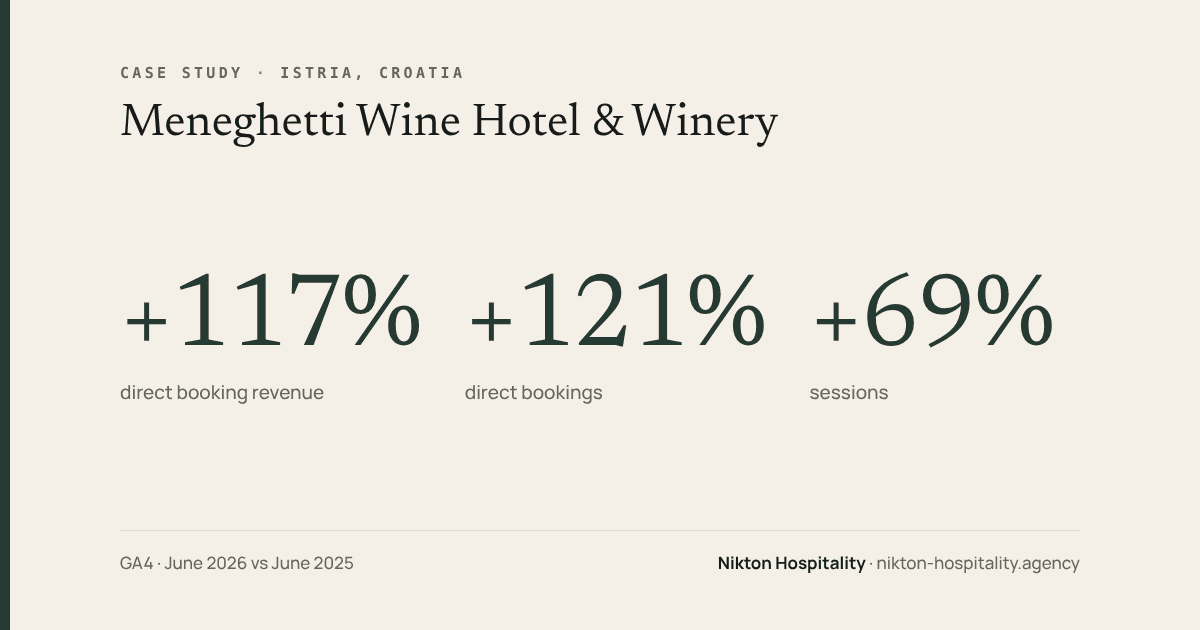
For Meneghetti, we’ve linked Google campaigns to confirmed bookings and revenue with a separate brand and non-brand overview across markets.
Google Ads
Brand and non-brand campaigns play different roles in hotel marketing. Here is how to separate them, track them and interpret the results.

Direct bookings
The cost per booking includes more than the media budget. Here’s how to calculate and compare it with the OTA commission without the illusion of free direct bookings.
We will review campaigns, the hotel website, tracking and the booking journey, identifying the most important issues and opportunities for growth.
No generic sales presentation. The first conversation is based on your hotel's actual website, booking journey and digital setup.