
Booking engine
Mobile booking experience: where hotels lose bookings
Check your mobile path from your ad to your booking confirmation: dates, prices, data entry, payment and measurement. A practical procedure for hotel and booking engine suppliers.
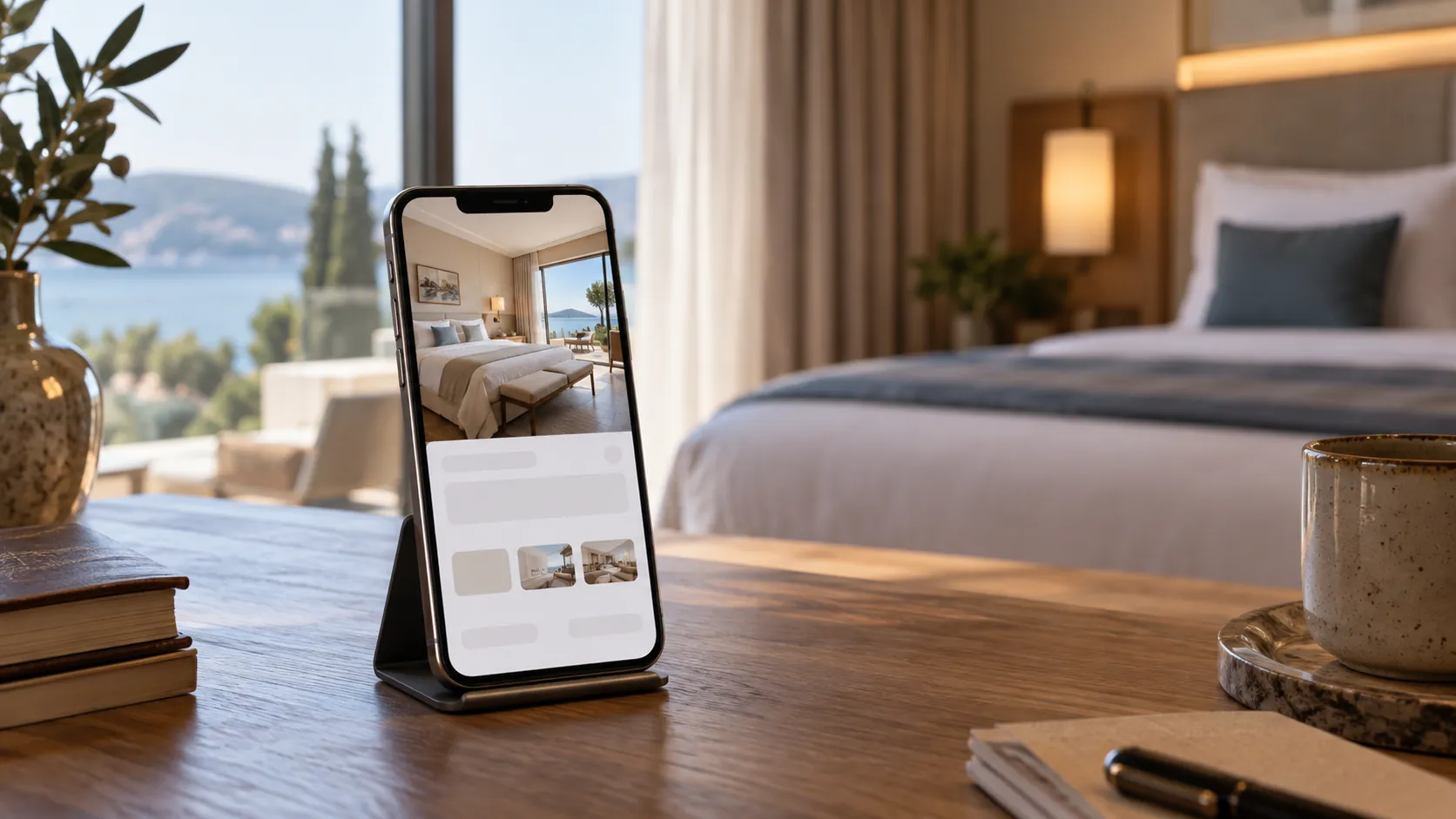
AI illustration
The mobile booking journey should be checked from the ad to the booking confirmation. A nice front page is not enough if the guest on the phone cannot change the dates, understand the total price or finish the payment. The first step is to repeat the actual path of the guest and record where they get stuck.
How to determine the mobile share of your hotel
Separate the share of visits, beginnings of bookings and confirmed bookings. These are different indicators. The hotel can have many mobile visits, and more bookings recorded on the computer. This in itself does not prove the problem: guests can explore on one device and book on another, and the measurement does not have to cover the whole journey.
Compare devices for the same period, market and source of traffic. Before concluding, make sure that the events are recorded equally on both versions of the booking engine. Use GA4 and booking engine guide as a starting point.
Test on a real phone
Open the same offer on iPhone and Android, preferably with a slower connection. Use the agreed test booking or test mode of the supplier, so that the check does not create unwanted bookings and charges.
| Step | What to check | What to note for the supplier |
|---|---|---|
| Arrival from the ad | Does the correct offer open? | Initial URL and selected language |
| Dates | Can the dates and number of guests be changed? | Device, Browser and Touch Sequence |
| Room selection | Are the terms and conditions clear? | Room, rate and total amount |
| Data Entry | Does the entry remain saved after an error? | Field and exact error message |
| Payment and confirmation | Is the guest coming back for confirmation? | Test time and booking status |
Check for text magnification, keyboard focus, and message readability. The booking button should not cover conditions, price or other controls. Additional checks can be found in booking engine checklist.
Display speed and stability
For an initial assessment, use PageSpeed Insights and real user data when available. Google's review of Core Web Vitals specifies thresholds for a good result: LCP up to 2.5 seconds, INP up to 200 milliseconds and CLS up to 0.1, at the 75th percentile. These are indicators of technical experience, not the promise of a certain booking rate.
The home page test does not necessarily describe a booking engine on another domain. Check both sides of the transition. Adjust photos to the view size; use lazy loading for images outside of the initial visible part, not automatically for the main image that determines page loading.
How to prioritize repairs
First, get rid of the blockages: a faulty calendar, lost form entries, a wrong price, or a failed payment. After that, evaluate friction such as unnecessary fields and hidden conditions. Supported payment methods depend on the supplier and the market; check out what the hotel can really offer.
For each problem, write down the proof, the responsible person and the method of re-checking. A lower conversion on a mobile phone is cause for investigation, but is not in itself proof of the cause.
How to assess the effect of change
Follow the same funnel step before and after, with sample size and price changes, availability and campaigns. When there is enough traffic, a controlled test can help separate the effect of the change from other impacts. In a small sample, report uncertainty instead of declaring a winner.
For a common overview of the website, measurements and suppliers, see hotel website and booking UX or request a hotel audit.
Related: case study Meneghetti Wine Hotel & Winery. Campaigns, the booking engine and direct booking results, June 2026 vs June 2025, source GA4.
Frequently asked questions
What percentage of direct bookings comes from mobile?
Check your own analytics. Separate visits, booking starts and confirmed bookings, and check measurement coverage. Without a defined dataset, there is no reliable percentage for all hotels.
Is a mobile website enough, or does the hotel need an app?
For most hotels, a responsive website with an optimised booking engine is sufficient. An app makes sense only for chains with a loyalty programme and repeat stays, rather than as a substitute for a poor mobile website.
Nikton Hospitality. A digital marketing agency for hotels.
About Nikton Hospitality and how we workRelated articles
Booking engine
Checkout optimization in the hotel booking engine
Checkout in the booking engine is the last step before revenue. Here’s where hotels lose guests, what to test and how to measure the effect of optimization without guessing.
Booking engine
Integrating a booking engine with GA4: practical steps
How to choose a supported GA4 integration for your booking engine, connect domains and agree event validation before using the data for marketing.